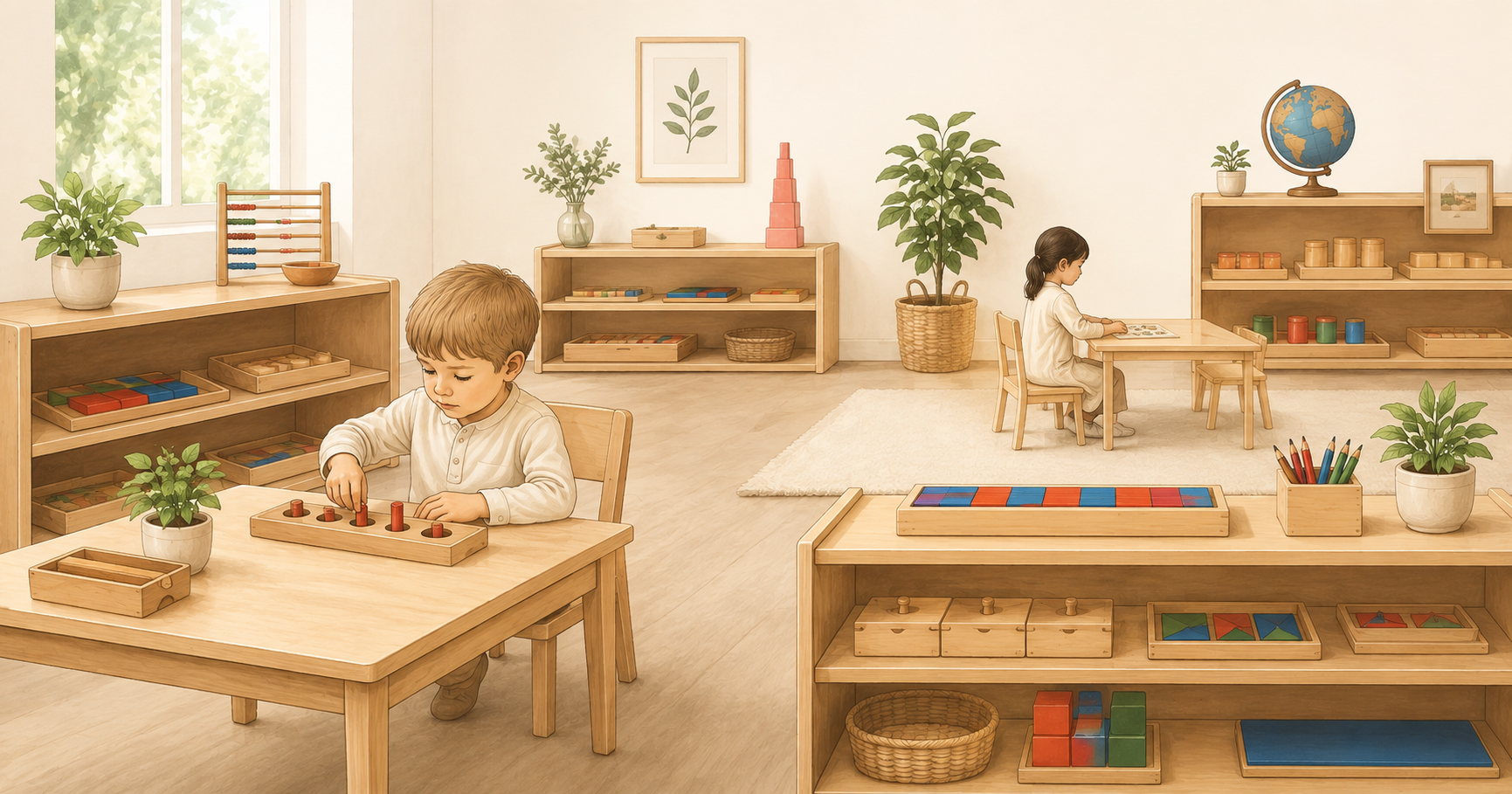
To a visitor, a Montessori classroom can look like a beautifully organized room full of wooden objects. To the children who work there, it is a carefully mapped landscape. Almost every Montessori environment is organized into five areas, each with its own shelves and its own purpose.
1. Practical Life
This is where many of the youngest children begin: pouring, spooning, buttoning, sweeping, food preparation, and care of the environment. These everyday activities build coordination, concentration, order, and independence — the foundation for everything else.
2. Sensorial
Sensorial materials help children refine and organize what their senses take in. Working with materials like the Pink Tower or the color tablets, children learn to discriminate size, shape, color, weight, sound, and texture — and to classify and make sense of the world.
3. Language
Language work moves from spoken language and vocabulary to sandpaper letters children trace with their fingers, to the moveable alphabet, and total writing and reading. Because the approach is multi-sensory and follows the child's own sensitive period for language, it often unfolds with remarkable ease.
4. Mathematics
Montessori math is famously concrete. Children hold quantity in their hands — number rods, bead chains, the golden beads — long before they work with abstract symbols. Big ideas like place value and the operations become tangible and, often, genuinely fun.
5. Cultural
The cultural area opens the wider world: geography, science, nature, music, and art. Children explore globes and maps, plant and observe, and begin to see themselves as part of a big, interesting world.
How the day flows
These areas come alive during the work cycle — a long, uninterrupted block of time in which children choose their own work, focus deeply, and return each material when they are finished. A guide moves quietly through the room, observing and offering the next lesson when a child is ready.
See how the five areas take shape across our infant, toddler, and preschool programs, or schedule a tour to watch a work period for yourself.