This is not a news flash: Handwriting instruction is disappearing in schools across the United States.
You’ve probably already heard about this trend. While it isn’t true for every classroom, more and more conventional schools are setting handwriting aside to make room for standard test-based skills. The result? A generation of children missing out on the joy and developmental power of writing by hand—and simply not learning cursive at all.
If that makes you cringe, here’s the good news: families and educators are speaking up, and some schools are finding ways to bring penmanship back.
Even better news? At Little Scholars Academy of California, we never dropped it in the first place.
As a school honored to be voted the Best Montessori School in Orange County for four consecutive years, we are deeply committed to protecting the foundational Montessori methods that nurture a lifelong love of learning. Read on to learn how this time-tested, 100+ year-old educational approach guides our young scholars from their earliest toddler moments into becoming confident, graceful writers.
Indirect Preparation: Building Strength Before the Pencil
If you walk into an LSAOC Infant, Toddler, or Primary classroom in Orange, you won't see three-year-olds forced into endless pencil-and-paper drills. Instead, you’ll witness young scholars joyfully engaging with purpose-built materials that naturally build fine motor proficiency.
Dr. Maria Montessori intentionally designed classroom materials that strengthen hand muscles as an indirect preparation for handwriting:
The Pincer Grip: Every time a toddler or primary child grasps a knobbed cylinder, they are refining the exact three-finger pincer grip needed to hold a pencil correctly.
Left-to-Right Orientation: From polishing silver to arranging practical life activities on their shelves, work is always sequenced from left to right—preparing the child’s eyes and hands for reading and writing directionality.
The child experiences pure joy and focus in their activity, while their tiny fingers are quietly building the precision and control needed for writing.
Manipulating a Pencil with Control and Stamina
Long before they are asked to compose a story or spell out words, Little Scholars learn how to feel confident and relaxed while holding a pencil.
Materials like the Metal Insets—beautiful geometric shapes in metal frames—were created specifically to prepare the hand for handwriting. While they look like an early geometry lesson, their primary purpose is building lightness of touch, proper pencil pressure, continuous movement, and physical stamina without fatigue.
Sensorial Letter Formation: Sandpaper Letters
When it comes time to introduce letter shapes, we engage the child’s tactile sense first.
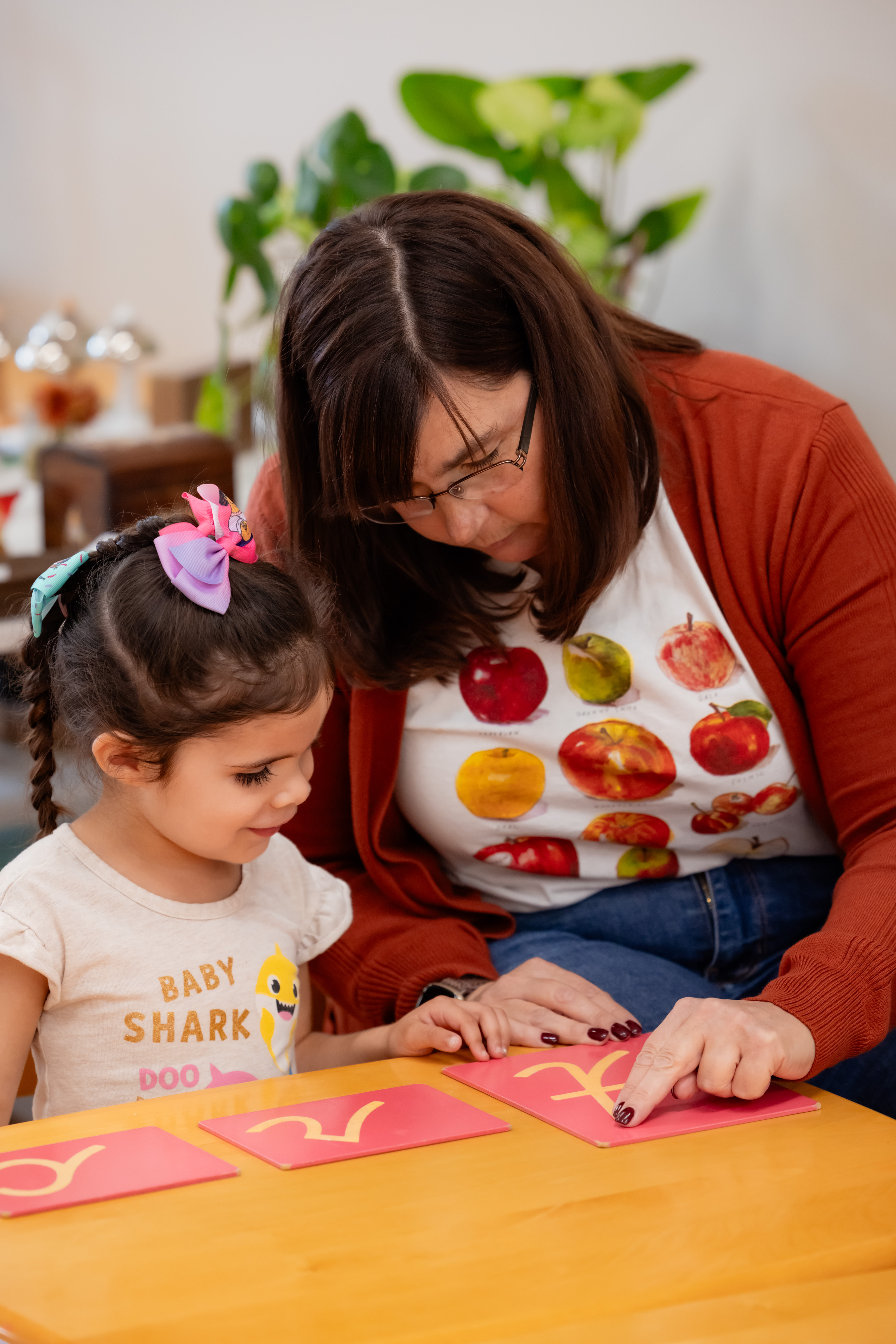
In our Primary classrooms, children work with Sandpaper Letters—wooden tiles featuring textured sand letters. Scholars trace the shape of each letter with their fingertips while hearing its phonetic sound. Another favorite classroom activity is "drawing" letters in a smooth tray of sand.
By linking touch, movement, and sound, letter formation becomes an inviting, multi-sensory experience rather than a tedious chore.
Cursive First: Why We Teach Cursive in Primary
By the time an LSAOC scholar reaches age 4 or 5, they begin writing spontaneously and joyfully because their hands and minds are completely prepared.
Visitors are often surprised to see our four-year-olds crafting continuous cursive script. While conventional programs introduce print first, authentic Montessori education emphasizes cursive from the start—and for very sound developmental reasons:
No Letter Reversals: Cursive letters naturally flow and start at different baseline points, making common print reversals (like b and d) virtually non-existent.
Flow of Thought: The fluid, continuous motion of cursive allows the child's mind to focus on their ideas and words rather than stopping and starting between individual letters.
Word Continuity & Spacing: Cursive ligatures visually connect letters, helping early readers recognize word boundaries and phonological chunks (such as th, sh, or ing).
Bridge to Print: Cursive writers pick up reading printed text effortlessly, whereas children taught print first often struggle to read cursive script.
Taking Pride in Beautiful Work
As our scholars progress through our programs, neat penmanship becomes a natural extension of self-expression and respect for one's own work. Our young scholars take tremendous personal pride in the elegance of their writing.
While technology and digital skills certainly have their place as children grow, our foundation ensures they never lose touch with the power of handwritten expression. In a fast-paced, shortcut-filled world, we love knowing that Little Scholars Academy graduates grow up enjoying the thoughtful, timeless art of putting pen to paper.
Interested in seeing our authentic Montessori classrooms in action? Schedule a personal tour at Little Scholars Academy of California today and see how we nurture physical, emotional, social, and academic excellence from six weeks to six years!