There is no doubt about it: Montessori is different. From the moment you step foot into our school, you know it is unlike any conventional school.
At Little Scholars Academy of California (LSAOC), we like it that way. We know what we offer across our Infant, Toddler, and Primary programs is special, and the families who join our community are looking for an environment that truly honors their child's holistic development.
What, exactly, makes authentic Montessori education at LSAOC so unique? Here is a look at the core principles that set our school apart.
Freedom Within Limits
One of the greatest misunderstandings about Montessori education is that either children run amok with no direction whatsoever, or the methods are so rigid that they allow for little to no variation.
Neither generalization is accurate. At LSAOC, we operate within the thoughtful middle ground: freedom within limits.
Montessori deeply values a child’s independence, autonomy, and choice. Scholars choose their work, where they sit, the order of their tasks, when to have a snack, and when to use the restroom. To support them in making these choices successfully, our Montessori guides create carefully crafted boundaries:
Curated Options: Children choose freely from materials carefully placed in the prepared environment to meet their specific developmental stage.
Purposeful Use: Scholars are shown how to use each material correctly and respectfully.
Mastery Through Repetition: If a child spends consecutive days on a single activity, we respect that deep concentration. Once they have extracted all the learning they need, they naturally move on to new challenges.
While we honor self-directed choices, our guides gently intervene and support scholars who may avoid certain subjects, ensuring a healthy balance between freedom and structure.
Multi-Age Classrooms
It is uncommon in conventional settings to find classrooms serving children across multiple age levels, but Montessori environments have done so successfully for over a century.
Multi-age groupings allow us to blend the lines between skill levels and foster a true sense of community:
Individualized Support: A child who needs extra support in language or reading does not feel isolated, as peers across different ages work at varying levels.
Academic Extension: An advanced student seeking a math challenge can easily access higher-level work already present in the multi-age environment.
Peer Leadership & Mentorship: Younger children observe and learn from older role models, while older scholars solidify their own mastery by teaching younger peers.
Deep Connections: Staying with the same guide and community for up to three years fosters trust, stability, and strong partnerships between guides, children, and parents.
Teachers as Guides
In conventional classrooms, the teacher is often the central focus, standing at the front to deliver information. In a Montessori environment, the child is the center of learning.
We believe the most impactful learning occurs through self-discovery. Our Montessori guides lead scholars to ask questions and discover answers independently, rather than dictating pre-scripted lessons. While we maintain a comprehensive curriculum that ensures mastery in foundational academics and cultural subjects, we deliver it by inspiring children to learn for themselves.
Individualized Pacing
Learning is not linear. No two children learn at the exact same speed, and every child progresses through natural starts, stops, and plateaus.
Rather than teaching the whole group at an average pace, our guides tailor instruction to each scholar:
No Unnecessary Waiting: Children who master a concept quickly are not held back waiting for the group; they are free to advance.
No Falling Behind: Children who need extra time receive direct, continuous guidance without the pressure of an arbitrary class timeline.
Formative Assessment & Observation
We do not assign traditional letter grades or standardized tests, yet our observational assessment model provides a much deeper understanding of each child's true progress.
Our guides maintain detailed daily records of each scholar's level of mastery. This ongoing, formative assessment allows us to adjust teaching strategies in real time during a lesson to meet a child's immediate needs. Instead of treating assessment as a final judgment on a report card, we use it as a constructive tool to review developmental goals and outline the next steps in learning.
Focus on Independence
Children—even our youngest scholars—are capable and eager to do far more for themselves than society typically expects. Independence is built through a gradual, supportive progression:
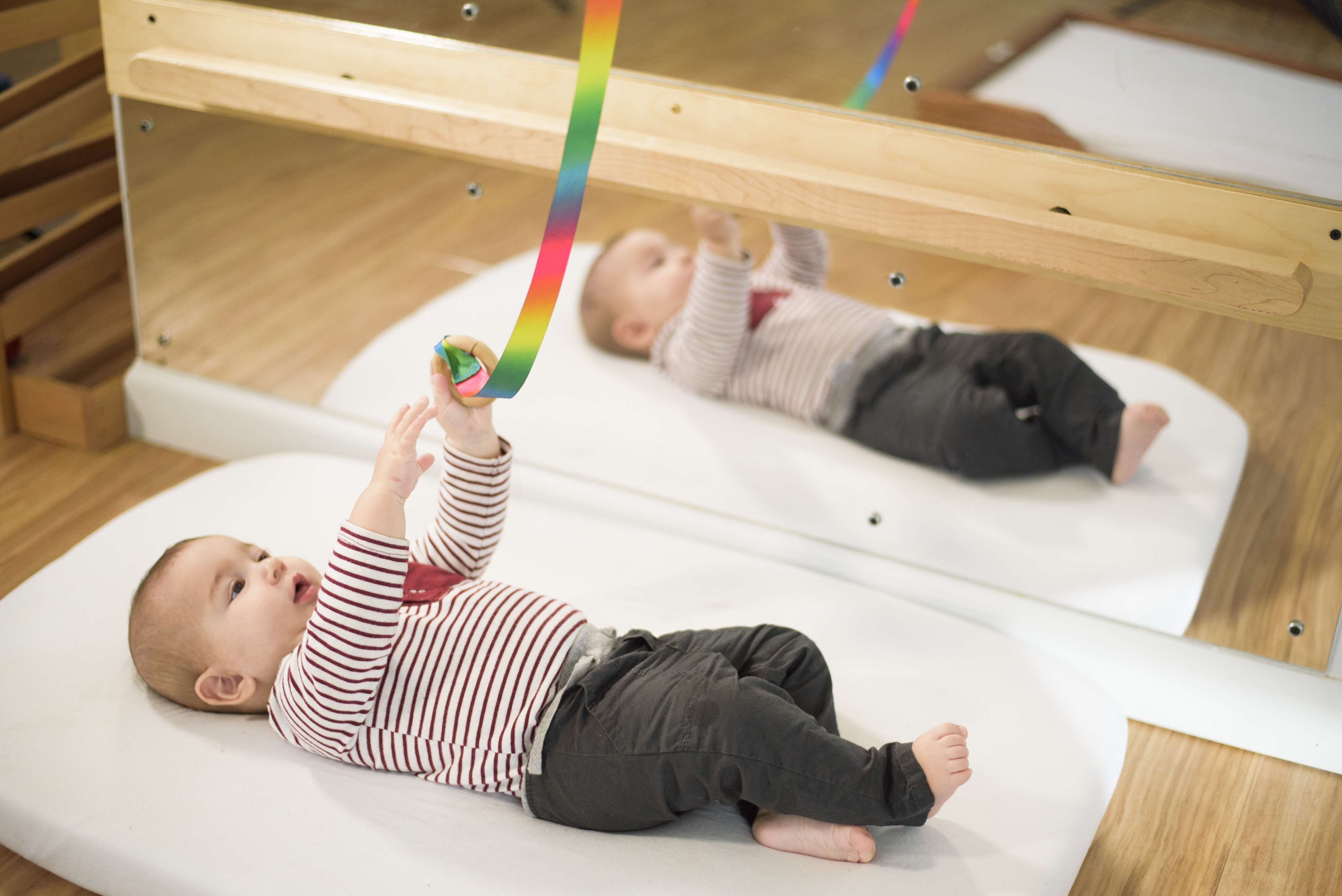
Infants (6 weeks – 18 months): Infants who can support their weight assist in their own care and explore purposeful movement.
Toddlers (18 – 30 months): Toddlers practice practical life skills, such as dressing themselves, pouring drinks, and maintaining their space.
Primary Scholars (2.5 – 6 years): Children master complex academic concepts, care for their classroom, and learn to resolve social conflicts peacefully.
By providing proportional support and clear boundaries, we help children build genuine self-reliance and confidence.
Developing Global Citizens
Our mission extends beyond academic excellence; we aim to nurture kind, creative, and responsible global citizens.
At LSAOC, we cultivate a joyful approach to learning, teach respect for self and others, celebrate individual differences, and instill a strong sense of community responsibility. Understanding how interconnected our world is provides scholars with a lifelong foundation for positive contribution.
Experience the Difference at LSAOC
Voted Best Montessori School in Orange County for four consecutive years, Little Scholars Academy of California is dedicated to helping your child thrive.
Curious to see our prepared environments and peaceful classrooms in action? Schedule a private tour today to connect with our team and discover how our Infant, Toddler, and Primary programs support your child's natural love of learning!